The Impact of AI on Game Development and Player Experience
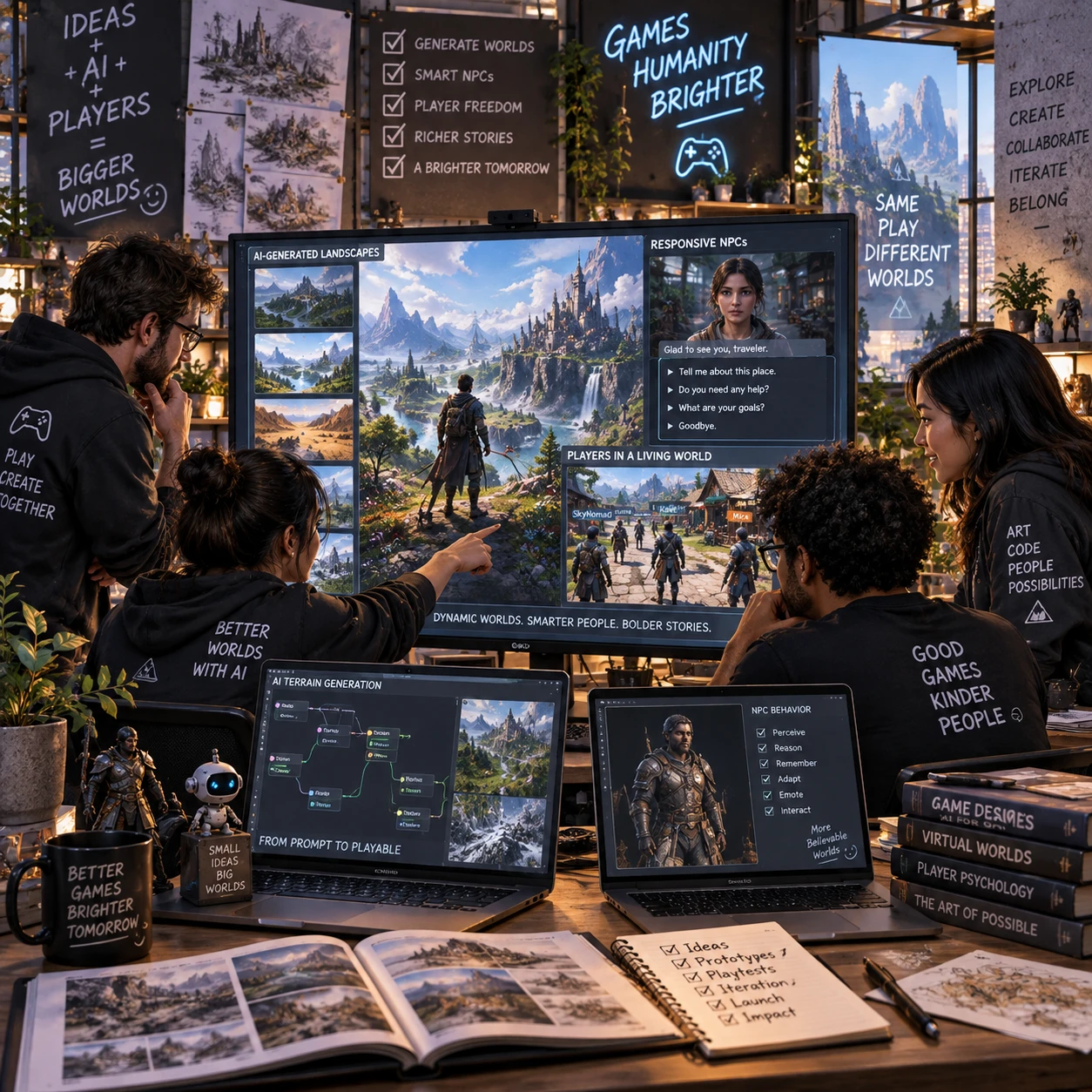
Artificial intelligence is changing how games are planned, built, tested, and played. It can help developers explore ideas faster, create more responsive non-player characters (NPCs), and adjust experiences to different players. These uses can make games feel richer, but they also raise questions about quality, creative control, and data privacy.
For players, the key distinction is between AI that supports a thoughtful design and AI used for its own sake. The most useful systems solve a clear problem, whether that is finding bugs sooner or making a challenge more accessible. Human creativity and judgment remain central to turning those systems into a coherent game.
How AI Is Changing Game Development
AI is changing game development by assisting with work across planning, production, testing, and live updates. It can speed up some repetitive tasks and help teams examine more options, while developers remain responsible for the game’s direction and quality.
During early design, a team might use AI to summarize player feedback, explore variations on a level concept, or generate rough reference material. In production, machine-learning tools can help classify assets or flag likely problems in large projects. These uses are best understood as support: a suggestion still needs review, and generated material may need substantial revision.
AI also helps with game testing and quality assurance (QA). Automated agents can repeat actions, navigate environments, and reveal crashes or progression blockers that are difficult to catch through a small set of manual playthroughs. Human testers still matter because they notice unclear tutorials, frustrating pacing, and strange interactions that a checklist may miss.
AI can reduce friction in a workflow, but it does not automatically reduce a game’s budget or schedule. Teams must evaluate tools, check output, and protect confidential project material. The practical question is whether AI improves a specific part of development without creating more review work than it saves.
AI in Game Design, Content, and Testing
AI can help developers generate and evaluate game content, but procedural content generation and generative AI work best when guided by clear design rules. Human review is essential for consistency, balance, and a satisfying player experience.
Procedural content generation creates or assembles content through rules, such as arranging rooms, terrain, or encounters from approved building blocks. This can increase variety, but more content does not always mean better content. Designers need to control pacing, difficulty, and the chance that a generated area will feel repetitive or unfair.
Generative AI can produce draft text, concepts, or other assets from prompts. A designer might use it to compare several descriptions for an item, then rewrite the strongest idea to fit the game’s world and tone. Generated material can be inconsistent, derivative, or inaccurate, so it should not pass into a release without checks for quality, rights, and fit.
Testing benefits from a similar mix of automation and expertise. Automated systems can run repeated scenarios and spot technical failures at scale, while human QA testers judge whether a mechanic is understandable and fun. For players, the result may be fewer bugs and more polished updates, though no testing approach can guarantee a flawless launch.
A useful workflow is to treat AI output as a prototype: define the task, generate or test options, review the results, and revise them against the game’s goals. This keeps speed from becoming a substitute for design.
Smarter NPCs and More Responsive Worlds
AI can make NPCs respond more convincingly to player actions by helping them choose behaviors based on context. Carefully designed systems can make a game world feel more reactive, although believable characters still depend on writing, animation, and clear limits.
Many games already use traditional AI techniques to guide enemies, companions, and crowds. An enemy might search near the last place it saw the player, retreat when outnumbered, or coordinate with nearby units. A companion could follow the player, avoid hazards, and provide support without blocking a doorway. These behaviors can make encounters easier to read and more engaging.
More flexible systems could let NPCs react to a wider range of situations or remember selected interactions. That possibility comes with design risks: a character may act out of tone, reveal information too early, or produce dialogue that feels repetitive. Developers need to test not only whether an NPC can respond, but whether the response belongs in the story.
For players, responsiveness is most effective when it supports the game’s intended experience. A stealth game benefits from enemies that notice patterns, while a story-driven adventure may need reliable character arcs more than unlimited conversation. Believable behavior is a design choice, not simply a matter of adding more computation.
Personalization, Difficulty, and Accessibility
AI can personalize parts of a game by adjusting challenge, assistance, or presentation to a player’s needs. Adaptive systems may improve accessibility and comfort, but they should be understandable, optional where possible, and tested with the people they are meant to help.
Adaptive difficulty can respond to signals such as repeated failed attempts, time spent on a section, or a player’s chosen settings. A game might offer an extra hint, reduce the number of incoming hazards, or make recovery from a mistake less punishing. The adjustment should preserve a sense of agency; a hidden system that quietly changes a challenge can feel patronizing or confusing.
Personalization can also support accessibility. Players may benefit from adjustable text size, simplified prompts, extra navigation cues, or alternative ways to receive important information. AI may help tailor these features, but it cannot replace accessible design fundamentals, such as readable menus, remappable controls, captions, and clear difficulty options.
Good personalization follows a simple test: does it help the player do what they came to do? Developers should offer clear controls, avoid making assumptions from limited behavior, and let players reset or disable adaptive features. A player who wants a demanding challenge should not have the game soften it without explanation.
The Limits and Risks of AI in Games
The main risks of AI in games are inconsistent output, reduced creative control, quality problems, and misuse of player data. Developers can limit these risks through human review, careful testing, transparency, and collecting only the information a feature truly needs.
AI systems learn patterns from their inputs, so their output can repeat familiar ideas or miss the detail that makes a game’s setting distinctive. Teams may also spend time correcting errors, checking ownership and permissions, or integrating a tool into existing production systems. A faster first draft is not a saving if it creates more work later.
Player data raises a separate concern. Adaptive features may rely on information about play habits, accessibility settings, or in-game behavior. Developers should explain what they collect, why they collect it, and how players can manage relevant settings. Avoid collecting personal data simply because a system could use it.
Common mistakes include:
- Using AI without a defined purpose: novelty can distract from the actual player problem. Start with a specific goal, such as reducing repetitive QA checks.
- Trusting generated content without review: errors can break immersion or introduce technical and rights issues. Check every asset and test it in context.
- Making adaptation invisible: unexplained difficulty changes can undermine trust. Tell players what is adjusting and provide controls when practical.
AI also cannot decide what a game should mean. That responsibility belongs to the people making it, including designers, writers, artists, engineers, and testers.
What AI Could Mean for the Future of Gaming
AI could give developers more ways to build varied worlds, test complex systems, and respond to individual player needs. Its value will depend on whether those capabilities improve the game, protect players, and leave room for human-led design.
As tools develop, teams may experiment with more reactive characters, configurable assistance, and faster ways to prototype content. These are possibilities, not guaranteed outcomes. Technical limits, production costs, safety concerns, and players’ preferences will shape which ideas become useful features.
For players choosing a game, it may help to look beyond claims about AI. Consider whether NPC behavior serves the story, whether difficulty and accessibility settings are clear, and whether the game explains its data practices. A well-made game can use AI in the background without making the technology the main attraction.
The strongest approach is a partnership: AI handles bounded, reviewable tasks, while people set the creative goals and make final decisions. That balance can support more responsive games without treating human creativity as an optional extra.
Frequently Asked Questions
These answers summarize the main ways AI affects game development and player experience, along with the limits players and developers should keep in mind.
How is AI used in game development?
Developers use AI to assist with content drafts, procedural generation, workflow tasks, automated testing, and analysis of player feedback. The final output still needs human review for quality, design fit, and technical reliability.
Can AI create a complete video game?
AI can help produce parts of a game, but a complete, polished game requires decisions about design, code, art, audio, testing, accessibility, and release. Current AI tools do not remove the need for a team to guide and check that work.
How can AI improve NPC behavior?
AI can help NPCs react to player actions, navigate environments, coordinate with others, or choose from context-appropriate behaviors. Good writing and careful limits are still needed to keep characters consistent.
Does AI make games more personalized?
It can, by adjusting difficulty, hints, or other features based on player choices and behavior. Personalization works best when players understand the changes and can control them.
What are the concerns about using AI in games?
Concerns include repetitive or inaccurate output, loss of creative control, bugs, questions about content rights, and collection of player data. Human oversight, thorough QA, and clear privacy practices help address these issues.